Monday, March 20, 2006

Wholeness – From Advaita Vedanta to Quantum Physics

Wholeness – Greeks, Vedas & Quantum Physics

The concept of ‘Wholeness’ or ‘Oneness’ is more than 2000 years old, from Greek philosophers in the Western civilization to the Vedic scholars in the Eastern culture. So, the debate over mind (Consciousness) and matter is not new. These concepts were broadly classified under Monism (in Greek, ‘monos’ means single) and Dualism.

Monism and Dualism from Ancient Greek Philosophers

The term monism was first used by a German philosopher, Christian Wolff (1679-1754), even though the philosophies date back to Ancient Greek philosophers. A prominent Greek philosopher, Parmenides, proposed matter and mind as a single entity. According to Monism, the ultimate reality comprises matter or mind (Consciousness), a third substance, or a combination of all.

Based on these, Monism is further classified into three.

Monism

Dualism

Materialistic

Idealistic

Neutral


Ernst Haeckel

Plato

Parmenides

S

Rene Descartes


George Berkeley

Baruch Spinoza

S


Immanuel Kant

Bertrand Russell

A


G W Hegel

Thomas Hobbes

A


Schopenhauer


G W Leibniz


1.

1. Materialistic Monism says everything in the universe comprises just one substance, ‘matter,’ and the mind is a by-product.

2. Idealistic Monism says everything in the universe is based on Consciousness (mind), and matter is an illusion.

3. Neutral Monism says that matter and mind can be reduced to form a new substance or energy.

· Substantival Monism (“One Thing”) believes that there is only ‘one thing’ and God, mind, and matter is part of this ‘one thing.’ The 17th-century Dutch philosopher Baruch Spinoza (1632-1677) proposed this view. Along with Western philosophers, Eastern mysticism also encourages similar views.

· Attributive Monism (“One Category”) believes that there is only ‘one thing’ however, it is made up of different things like matter and the mind. It disagrees with substantive monism, emphasizing that reality is not made up of ‘one thing’; instead, it is composed of multiple things.

In Hinduism, Advaita Vedanta subscribes to Substantival Monism, emphasizing the atomicity of the mind and the matter, while in Buddhism, all things are part of a connected world. Creationist philosophy supports the belief that God (Consciousness) and the creature (subject) are separate entities. God is the supreme, and ‘Idealism’ is the only theologically acceptable Monism.

One should know that nature is an illusion (Maya), and Brahman is the illusion maker

- Svetasvatara Upanishad

Dualism

Monism & Dualism in Eastern Mysticism

(work in progress………… watch out this space….)

Tuesday, January 25, 2005

President Kalam's mantra for national prosperity

Following is an extract from Indian President Kalam's Republic Day speech echoing the same concerns I raised in India's blog in 2020.

Changing Pattern of Society

When the world moved from the industrial to the information and knowledge era, we witnessed a changing pattern in the sectoral share of Gross Domestic Product and the number of people employed in each sector. The share of GDP percentage has undergone a considerable change. The contribution of agriculture to India's GDP has reduced from 39 percent to 22 percent during the period 1979 to 2004. During the same period, the gift of the manufacturing sector has moved from 24 percent to 27 percent, whereas the assistance of the service sector has increased from 37 percent to 51 percent. There has been considerable change in the employment pattern. The percentage of people employed in agriculture has decreased from 64 percent to 54 percent. Simultaneously, the percentage of people engaged in manufacturing has increased from 15 percent to 19 percent, and in the service sector from 20 percent to 27 percent. This trend has to continue, and by 2020, our employment pattern should aim at 44 percent in agriculture, 21 percent in manufacturing, and 35 percent in service sectors. The displacement of 10 percent of people from the agriculture sector has to be facilitated through skill enabling for undertaking value-added tasks in rural enterprises to reduce migration to urban areas. Instead of people from rural areas going to urban towns in search of jobs in the manufacturing and services sectors, PURA (Providing Urban Amenities in Rural Areas) will facilitate the creation of employment in rural areas. PURA achieves this by providing physical, electronic, and knowledge connectivities to a cluster of villages, thereby leading to their economic connectivity and prosperity.

National Employment Status

The National Rural Employment Guarantee Bill 2004 was tabled in Parliament in its last session to create employment opportunities in the rural sector. What is needed is coordinated planning and linking this Bill's spirit to productive and sustainable employment generation schemes for the unemployed youth. Now, I would like to discuss the national employment scenario.

As per the estimates of the Planning Commission, the total number of people eligible for employment currently is approximately 400 million. Out of this, nine percent are unemployed, around 36 million. In addition, there is a need to find value-added employment for 10 percent of those employed in the agriculture sector in rural areas. Our attempt is to find gainful employment for around 76 million people. This will add to our productivity and ensure a sustained 10 percent GDP growth for the decade, an essential need for India to become a developed country before 2020.

Dear Citizens, a nation of a billion people that is capable of exporting foodgrains, a nation that is recognized for its software products and services, a nation that can build its own aerospace systems and nuclear power plants, a country that is leading in the pharma and automobile industries, I am sure, will be able to put all its think tanks together and come up with many innovative wealth generating schemes for the productive employment of 76 million people.

The complete text of President A P J Abdul Kalam's address to the nation on the eve of the country's 56th Republic Day is available at this URL: http://us.rediff.com/news/2005/jan/25prez.htm

Friday, January 21, 2005

India in the year 2020

India's foreign reserves are around $131 billion (as of Jan 1, 2005) dollars. However, what is disturbing is our GDP and Labor force distribution.
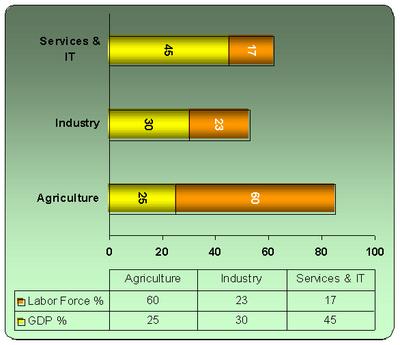
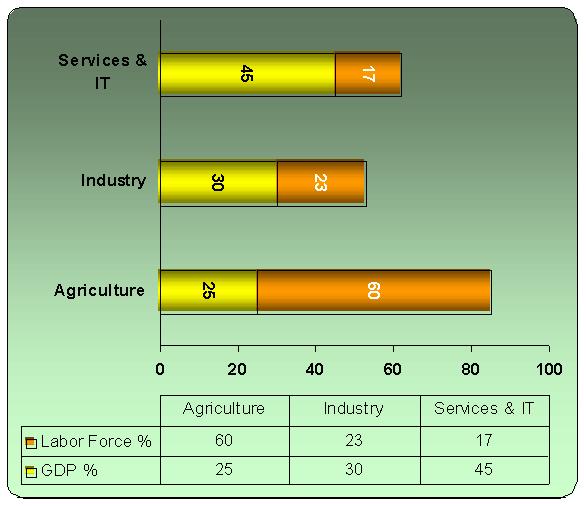
GDP1 (Gross Domestic Product) Distribution.

- 25% is from Agriculture
- 30% is from Industry (of which 19% is manufacturing)
- 45% is from Services & Information Technology

Labor Force: 470 million

Labor Force Distribution

- 60% Agriculture
- 23% Industry
- 17% Services & Information Technology

The decline in the contribution of agriculture towards GDP for the past two decades is in sync with the growth pattern of any developing country. The share of agriculture in the GDP has shrunk to 25% in 2004 from 40% two decades ago. However, the labor force reduction was only 10%, i.e., from 70% two decades ago to 60%.


INDIA

China

USA


2004

2020

2004

2004


GDP

Labor

GDP

Labor

GDP

Labor

GDP

Labor

Agriculture

25%

60%

10%

15%

14.8%

50%

1.4%

2.4%

Industry

30%

23%

35%

35%

52.9%

22%

26.2%

24%

Services & Others

45%

17%

55%

55%

32.3%

28%

72.5%

73%

Labor Force

470 Million

700 Million

778.1 Million

146.5 Million

Public Debt2

59.7 % of GDP


30.1 % of GDP

62.4% of GDP

Exports

$57 Billion


$436 Billion

$714 Billion

Imports

$74 Billion


$397 Billion

$1.26 Trillion

GDP per Capita3

$2900.00


$5000.00

$37,800.00

PPP4

$3.033 Trillion


$6.449 Trillion

$10.99 Trillion

GDP Real Growth Rate5

8.3%


9.1%

3.1%

The transformation in the GDP is typical of developing country experience. However, if you look at the labor force distribution, we find that 75% of the GDP contribution comes from 40% of the labor force.

All successful developing economies moved significant numbers of people out of agriculture as the share of agriculture in the GDP declined. The developed nations' GDP (see the US) shows this fact.

So, over here, 60% of (Labor force) our population is dependent on Agriculture, and imagine the chaos it will create when there is monsoon failure. Another misconception is that while China has become the world's factory, India has become the world's knowledge centre in the last 10 years – which looks better on paper. China did the right thing in the previous 15 years to transform its agricultural labor force by bringing in industrialisation, which is natural progress (Agriculture to Industry to Service). 

Thanks to the liberalisation of the early 1990s, India did pretty well in the last 15 years. However, we did pretty well in the Service and IT (Information Technology) sectors, neglecting our Agricultural labor force. So, to bring our 60 Agriculture labor force down to 15% – 20% (i.e., approximately 220 million people), we need to create more jobs in our industry sector and have a good plan and commitment to do the transformation.

We (India) could become an economic giant in 2020 if we could move people from Agriculture to other industries, and how do we do that?

Education with an adequate skill set!

We need governments who could see into the future to do this transformation.

The question over here is –

WHAT CAN WE (The people of India) DO TO HELP THIS TRANSFORMATION?

1. GDP – Gross Domestic Product is the value of all final goods and services produced within a nation in a given year.

2. Public Debt – All government borrowings minus repayments denominated in a country's home currency. It should not be confused with external debt, which reflects the foreign currency liabilities of private and public sectors and must be financed out of foreign exchange earnings.

3. GDP Per Capita - GDP on a purchasing power parity basis divided by population.

4. PPP – Purchasing Power Parity (2004 estimate).

5. GDP Real Growth Rate - GDP growth is annually adjusted for inflation and expressed as a percent.